Make Villager Orders Tell Small Stories in a Cozy Game
An illustrative design exercise for connecting villager requests, personal props, and visible consequences without making cozy orders harder to read.

THE SHORT ANSWER
Connect each villager order to a recognizable need, a personal visual clue, and a small consequence the player can notice afterward. Keep the requested item and completion action explicit so the story adds meaning without becoming a puzzle. The exercise below explores possibilities inspired by Mossbrook’s documented villager-order premise; these are hypothetical designs, not shipped features.
Give the order a reason beyond its recipe
A potion order can communicate more than an item and a quantity. It can suggest what someone cares about, what interrupted their day, or how they contribute to village life. My recommendation is to begin with an ordinary intention: preparing a gathering, tending a garden, or helping a neighbor. That intention gives the art team something specific to express.
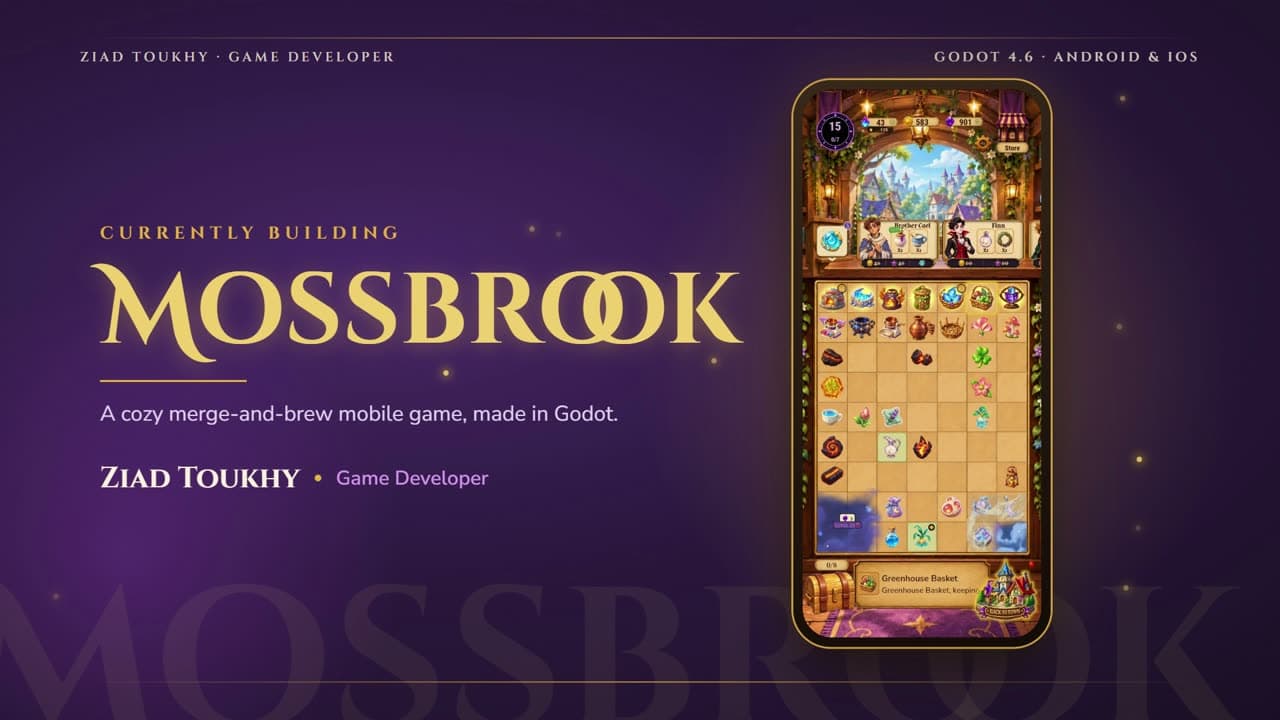
Mossbrook’s documented premise includes a young witch restoring a potion shop, merging ingredients, brewing potions, and filling villager orders. It provides the starting point for this exercise. The characters, requests, and reactions proposed here are illustrative possibilities, not announcements about implemented content. See the supplied [Mossbrook project context](https://ziadeltoukhy.com/#mossbrook).
Write a single sentence before drawing: this villager needs this potion because something matters to them today. If that sentence only explains the recipe, develop the situation further. A useful request reveals a preference, responsibility, or relationship that could remain recognizable when the requested item changes.
Connect a visual clue to a visible consequence
Build the miniature story around three moments: the villager arrives with a clue, the player fulfills an explicit request, and a later image acknowledges what happened. Give each moment a different job. The clue invites curiosity; the request tells the player what to do; the consequence makes the completed action feel connected to village life.
Harvey Smith and Matthias Worch’s GDC session describes environmental storytelling through props, composition, implied events, and environmental reactions. Applying that principle to orders is a design proposal: let a carried object establish a situation, then let its changed state suggest an outcome. [What Happened Here? Environmental Storytelling](https://www.gdcvault.com/play/1012696/What-Happened-Here-Environmental).
The consequence need not require a new location or a cinematic. In an illustrative treatment, a returned basket could contain seedlings where it previously held empty pots. Choose a change that answers the original clue. An unrelated celebratory flourish confirms completion, but tells us little about why this particular villager needed help.
Exercise: turn a gardener’s request into three images
For a hypothetical exercise, imagine a gardener preparing seedlings for a shared courtyard. Their request is one growth potion. Start with a rough arrival image: the gardener holds a tray containing one small sprout and several empty planting cups. Their attentive posture suggests care. Avoid making distress the only way to give the order significance.
Next, sketch the order itself. Display the required potion and quantity plainly, with a short explanation that the gardener is preparing plants for the courtyard. The planting tray supplies context; it does not replace the item requirement. Keep the same potion representation used wherever the player identifies that item.
Finally, sketch a return visit. The tray now holds several healthy seedlings, with one cup set aside for someone else. This suggests both an outcome and generosity without requiring a long exchange. It remains a proposal for a visual story, not a claim about Mossbrook’s characters or systems.
Place the three sketches side by side and remove their dialogue. Can a reviewer describe the broad change? Then restore the order information and ask what must be delivered. If the story reads but the task does not, repair the request. If the task reads but the consequence feels arbitrary, strengthen the connection between the first and last image.
Keep personality clear without obscuring the task
A personal prop can become confusing when it resembles a collectible or a delivery target. Decide which objects are decorative, which communicate the request, and which accept input. Give actionable elements consistent interaction cues across villagers, even when their clothing, possessions, and mannerisms differ.
Game Accessibility Guidelines recommends clear, consistent visual differences or additional signifiers for interactive elements, explaining that some players can struggle to distinguish them. Use that guidance to protect the order’s controls while giving narrative details room around them. [Give a clear indication that interactive elements are interactive](https://gameaccessibilityguidelines.com/give-a-clear-indication-that-interactive-elements-are-interactive/).
For this exercise, keep the completion control in a predictable place and avoid making a carried basket look pressable unless it actually responds. Let players understand the delivery without interpreting an expression or recognizing an occupation. The narrative can reward attention while the required action remains explicit.
Budget for recognition and follow-through
Before expanding the cast, list what each proposed story requires: a carried prop, an alternate prop state, a pose, a line of dialogue, and any conditions needed to show the return. A charming sketch becomes a production commitment when its consequence needs to persist or appear in a particular order.
Use a small review sheet with the initial need, required item, visual clue, and acknowledged outcome. Flag any request whose meaning depends on unseen events. For recurring villagers, retain one recognizable possession or concern while changing the immediate situation; that creates continuity without demanding a new identity for every order.
Review the proposal with art, writing, and game design together. Ask whether the consequence is feasible, whether its appearance follows fulfillment, and whether repeat orders would contradict it. Approve a complete small story before commissioning a large set of disconnected portraits and requests.
Key takeaways
- Give each order an ordinary personal reason that can be expressed visually.
- Sketch an arrival clue, an explicit delivery request, and a related consequence.
- Keep required items and interaction cues understandable without interpreting the story.
- List alternate assets and display conditions before expanding the number of villager stories.