Plan a shop restoration arc with visual anchors
Map a shop restoration arc around recognizable features, meaningful repairs, and clear stage changes in an illustrative art-planning exercise.
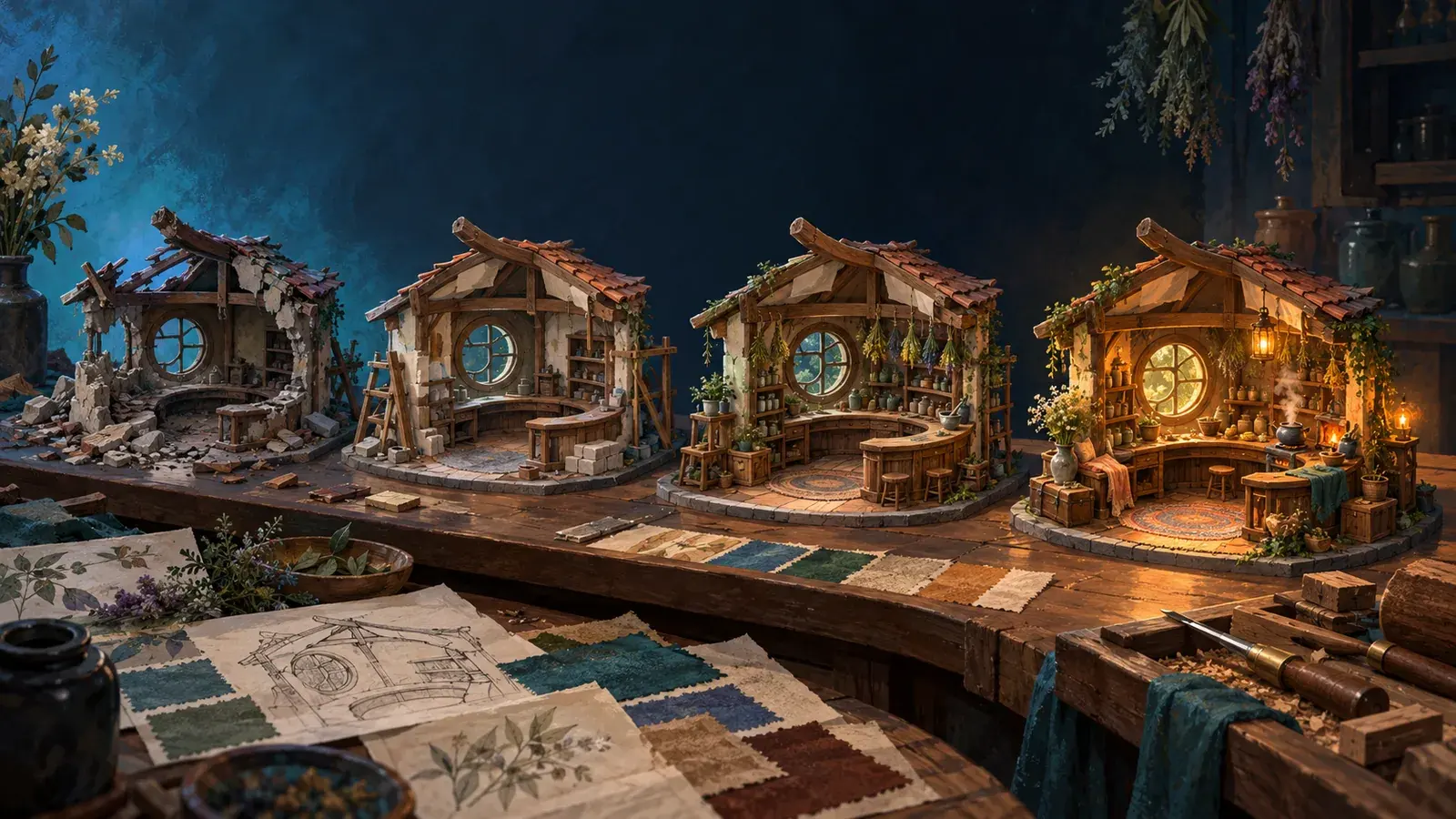
THE SHORT ANSWER
Plan restoration around a few recognizable features that survive every stage. Give each milestone a distinct change in condition, use, or personal ownership, then compare all stages from the same camera. Preserve enough history for the final shop to feel earned. The exercise below draws on Mossbrook’s documented premise; it does not describe implemented restoration stages.
Choose the features that make this shop recognizable
A restoration arc needs a clear answer to one question: what makes this the same place after everything improves? Start with three visual anchors, such as an unusually shaped window, a curved counter, and a ceiling beam with a visible repair. Choose features that occupy different parts of the composition. Their continuity gives the art team something concrete to preserve while the surrounding room changes.
Mossbrook’s documented premise includes a young witch restoring a potion shop, alongside merging ingredients, brewing potions, and filling villager orders. That provides a useful starting point for this hypothetical planning exercise. The proposed anchors, milestones, and reviews here are illustrative recommendations, not claims about the game’s implementation. The project context appears in the [Mossbrook portfolio entry](https://ziadeltoukhy.com/#mossbrook).
Architectural conservation offers a useful analogy. The National Park Service’s rehabilitation standards emphasize retaining features and spatial relationships that convey a building’s character. A fictional shop does not need to follow preservation regulations, but the principle can guide art decisions: identify what carries identity before deciding what to replace. [Standards for Rehabilitation](https://www.nps.gov/articles/000/treatment-standards-rehabilitation.htm)
Give each milestone a different meaning
Avoid defining the entire arc as increasing cleanliness or expense. Those are narrow measures of improvement. Instead, assign each milestone a sentence about the shop’s changing life: safe enough to work in, ready to serve visitors, comfortable to inhabit, and finally expressive of its owner. These sentences should lead to different visible decisions.
A safety milestone might repair a broken shutter and stabilize shelving. A service milestone might establish a clear place for completed orders. A personal milestone might add a handwoven cushion or a carefully tended plant. Each change answers a different need. Decorative richness can increase, but it should follow the milestone’s purpose rather than become the purpose itself.
Decide which traces of age remain. An old counter can become polished without losing its patched corner. This gives restoration a more specific character than replacing every object with a pristine upgrade. In its discussion of cumulative change, the National Park Service notes that numerous alterations can collectively damage character. Applied here as a design analogy, even attractive upgrades deserve review as a complete sequence. [Cumulative effect and historic character](https://www.nps.gov/subjects/taxincentives/cumulative-effect-and-historic-character.htm)
Exercise: draw four states of one room
For an explicitly illustrative exercise, sketch a fictional herbalist’s shop from one fixed camera. Keep a round window, a bent timber beam, and a crescent-shaped counter in every drawing. Use simple shapes first. The task is to make the restoration sequence understandable before committing to finished materials or decorative objects.
In the neglected state, a fallen shelf blocks part of the counter, the window has a cracked pane, and tools sit in an improvised crate. In the repaired state, the shelf stands securely and the pane is replaced, while the counter keeps its old joinery. The room now communicates basic care through structural changes.
In the working state, add organized storage and a dedicated packing surface. In the settled state, introduce a repaired stool, a plant growing around the window, and a small display of treasured objects. Keep the bent beam visible throughout. The proposed story moves from damage to usefulness to belonging, with each stage contributing a different kind of evidence.
Place the four drawings beside one another and ask a reviewer to describe the changes without seeing the milestone sentences. If two states receive the same description, revise their main transformation. This is a planning review, not evidence of player comprehension; actual player responses would require separate testing.
Spend production effort on visible transformations
Make a change ledger for each anchor and its surrounding zone. Record what stays, what changes, and what depends on another change. A repaired window may need a new pane and altered light treatment; it does not automatically require rebuilding the wall. This ledger turns the restoration story into a bounded art workload.
Separate permanent progress from temporary decoration. If seasonal dressing can cover the window, counter, and repaired beam simultaneously, the shop may lose the evidence that establishes its history. Reserve areas where those anchors remain visible, then let optional decoration occupy more flexible spaces.
Review adjacent milestones as well as the beginning and ending. A dramatic final room can conceal a weak middle sequence. Each transition should contain one readily describable change, with smaller supporting adjustments. If a milestone needs many tiny additions to explain itself, reconsider whether a larger repair or a clearer change of use would communicate its purpose more economically.
Approve continuity before polishing individual stages
Review the entire strip at the intended gameplay framing. Check whether the anchors remain recognizable, whether each stage expresses its assigned meaning, and whether the final room still belongs to the same building. Also examine any decoration options that could obscure essential evidence. A beautiful isolated illustration is insufficient to approve the progression.
Finish with a short decision record: preserved features, milestone meanings, required transformations, optional dressing, and unresolved dependencies. Approve that record with the sequence. It gives later contributors a reason to retain an awkward old beam or a repaired counter when a cleaner replacement looks tempting. The restoration arc then has a consistent argument about what deserves to survive.
Key takeaways
- Choose three recognizable anchors before designing restoration stages.
- Give each milestone a distinct purpose beyond looking cleaner or more expensive.
- Compare all stages from the same camera and review every adjacent transition.
- Record preserved features and separate permanent progress from optional decoration.