Use an Art Review Exercise to Evaluate Creative Leadership
Design a fair art leadership interview using permitted existing assets, a bounded review task, shared scoring criteria, and clear candidate protections.
THE SHORT ANSWER
Give candidates the same permitted artwork, brief, constraints, and time limit, then ask them to identify priorities and explain one next decision to an artist. Score their reasoning, clarity, handling of uncertainty, and response to new information against defined criteria. Keep the exercise separate from live production, disclose its boundaries in advance, and combine its evidence with portfolio discussion.
Choose the leadership decision you need to observe
A polished portfolio does not show every decision behind the images. An interview review exercise can make a candidate's reasoning visible: what they notice, what they leave alone, and how they explain a change. My recommendation is to test a narrow leadership responsibility rather than ask for a complete visual overhaul in an unfamiliar project.
The US Office of Personnel Management describes [work samples and simulations](https://www.opm.gov/policy-data-oversight/assessment-and-selection/other-assessment-methods/work-samples-and-simulations/) as tasks that mirror work performed on the job. It also notes that these assessments suit competencies expected on entry. Applied to an art leadership role, that supports choosing an actual responsibility such as interpreting a brief and prioritizing a review, rather than testing obscure software shortcuts.
Write the hiring question first. For example: can this person distinguish a problem that threatens the intended experience from a preference that can wait? Decide what evidence would answer it. A candidate should have room to reach a different visual conclusion while still demonstrating sound judgment.
Prepare existing materials with clear boundaries
Build a small packet from studio-owned training assets, licensed materials whose terms permit this use, or work shared with explicit permission for assessment. Verify permission before distributing files. Include a brief, a target display context, the asset's current stage, and a short account of the available production capacity. Remove confidential information and identify any missing context deliberately.
Keep the packet separate from an active production problem. State that the candidate's response will be used only for assessment and will not become a production instruction. Do not ask them to reveal confidential work from a previous employer. These are recommended professional boundaries for the exercise, rather than claims about a universal hiring rule.
Disclose the duration, deliverable, evaluation criteria, permitted tools, and any recording before the session. Invite accommodation requests and agree an appropriate format in advance. A proposed default is a 45-minute session with no required preparation: ten minutes to read, fifteen to review, ten to explain priorities, and ten for discussion. If the task expands into substantial take-home work, reduce it or agree compensation beforehand.
Exercise: review a fictional expedition equipment set
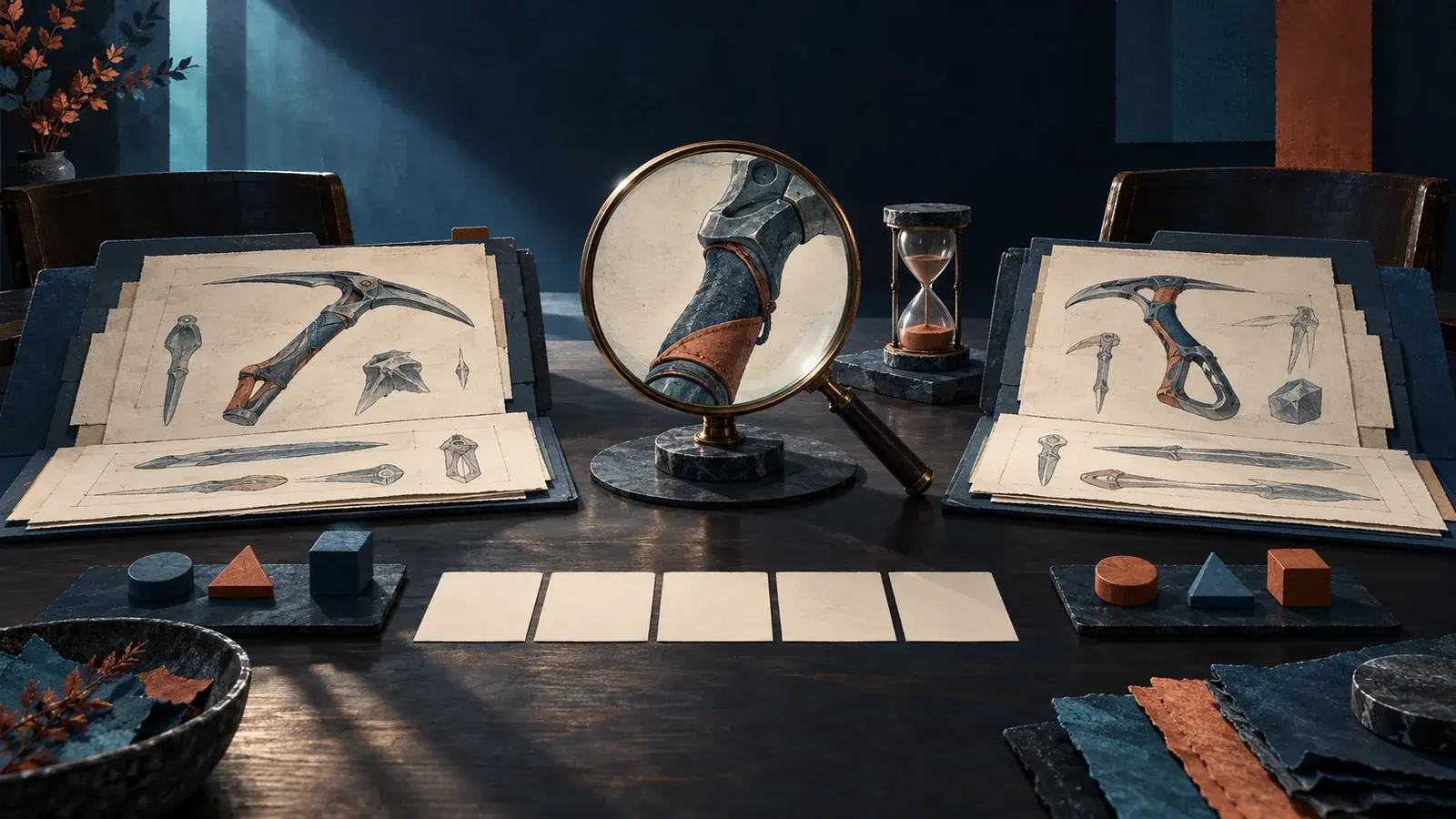
This illustrative scenario uses an invented exploration game and permitted training artwork. It does not describe an interview conducted by Ziad. The packet contains three equipment props, a sample scene, and a brief asking for practical tools with a restrained decorative language. One prop has an elaborate crest; another has an ambiguous grip. The team has capacity to revise one asset before the next internal review.
Ask the candidate to select one priority, explain why it matters, identify what should remain, and give a short instruction to the responsible artist. A defensible response might prioritize the grip because it obscures how the tool is held, while postponing the crest until its narrative purpose is known. Another candidate might prioritize the crest if they establish that it contradicts a central brief requirement.
Then supply the same additional fact to everyone: the ambiguous tool is carried by a mechanical mount rather than a hand. Ask what changes. Look for a reasoned update, including a decision to retain the original priority if the new context does not resolve the underlying concern. Do not treat immediate agreement with the interviewer as the desired behavior.
Finish by asking the candidate to restate the next action in two sentences for the artist. This makes the handoff observable without requiring a paintover, new concept art, or a polished presentation.
Use the result as bounded evidence
Have reviewers record scores independently before discussing them. Compare the evidence behind disagreements: which statement demonstrated prioritization, and which instruction remained ambiguous? If the packet repeatedly requires rescue explanations, revise the assessment rather than quietly blaming candidates.
Combine the result with portfolio ownership questions and discussion of past collaboration. A short simulation cannot establish sustained team leadership or delivery performance. Its useful contribution is narrower: it reveals how someone reasons through a shared art problem, communicates a decision, and responds when the context changes.
Key takeaways
- Test one responsibility that the role requires on entry.
- Use existing materials with verified permission and keep the task outside live production.
- Disclose time, tools, deliverables, and criteria before the assessment.
- Score observable reasoning and communication against shared anchors.
- Introduce the same new information to every candidate and examine how they respond.
- Combine the exercise with other evidence of leadership.