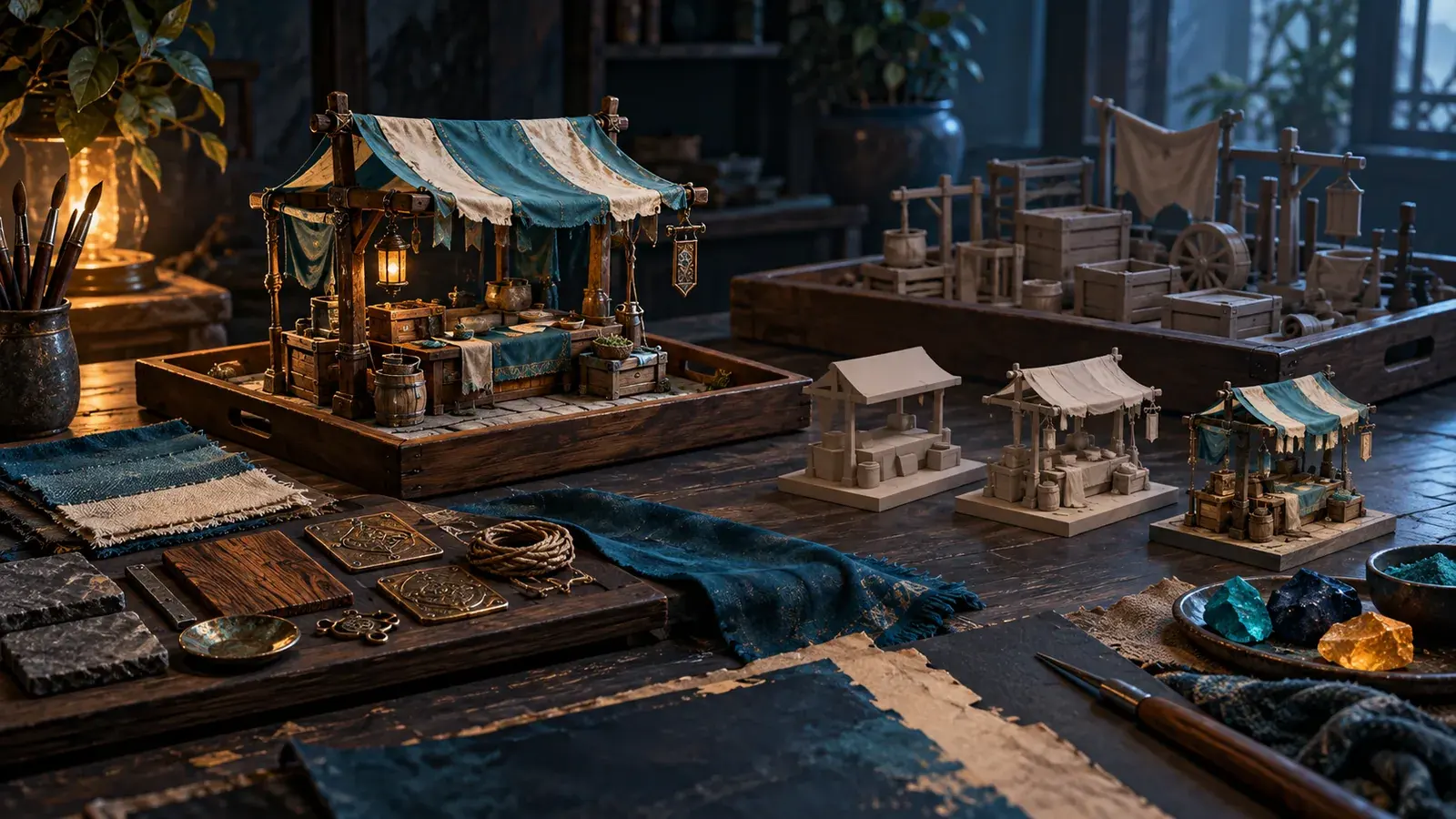
Choose representative assets before scaling a new art style
Select a character, environment slice, object family, and key UI screen to expose production risks before scaling a new game art style.

THE SHORT ANSWER
Choose a small asset set that tests different production questions: character readability, environmental assembly, family variation, and interface hierarchy. Approve the evidence needed to scale, rather than relying on one impressive image.
Choose assets that answer different questions
The short answer: select a character, an environment slice, an object family, and a key interface screen because each exposes a different weakness in a proposed style. Choose ordinary assets with meaningful constraints, then define what each must demonstrate. A striking showcase image can establish appeal while leaving repeatability and integration unresolved.
Representative means relevant to the work the team will produce repeatedly. An exceptional boss, ceremonial room, or promotional composition may demand unusual treatment. Include an exception only when it addresses a central risk. The core set should reveal whether the style holds together under everyday proportions, interactions, and production requirements.
Ziad El Toukhy’s documented Nanotopia responsibilities include visual language, character and environment direction, and consistency across three titles. That provides context for the challenge of scaling visual decisions. The asset selection process described here is a recommendation, rather than a claim about the development sequence used at Green Rabbit Games.
Use a character and environment slice for structural risks
Choose a character that encounters common gameplay demands. It should show how the proposed proportions, silhouette, and surface treatment behave at the intended camera distance. Include relevant pose or equipment variations when they affect the style. Ask whether the identity survives smaller presentation and whether ordinary changes can be made without rebuilding the design.
The environment slice should include enough neighboring elements to test assembly. A single beautiful wall cannot establish how walls, floors, props, lighting, and navigation cues relate. Choose a bounded area with a representative junction or transition. It should expose repetition, scale relationships, and the point where decorative detail begins to compete with gameplay information.
Define acceptance questions separately. For the character: are the role and major forms readable in the relevant views? For the environment: do assembled parts maintain the intended density and focal structure? Both should also reveal whether the proposed work can be edited and integrated using the team’s intended production setup.
Use an object family and UI screen for variation risks
An object family tests whether the style can generate related assets without producing near-duplicates. Select members with meaningful differences in size, purpose, or progression. Review them together. Ask which features establish family identity, which distinguish individual objects, and whether the distinction remains visible when the assets share the same display space.
A key UI screen tests the style under information pressure. Select a screen that contains a real mixture of priorities: primary action, supporting information, repeated elements, and longer labels. Avoid choosing only a sparse opening screen if the game’s ordinary interface is dense. Review relevant selected, unavailable, or warning states as part of the same screen.
Acceptance questions should concern behavior as well as appearance. Does the primary action remain clear? Can repeated components accommodate changing content? Do decorative treatments survive smaller sizes? An attractive static composition is incomplete evidence when the interface must support different amounts of information or communicate changing status.
An illustrative set for a small adventure game
Imagine a hypothetical adventure game proposing compact proportions, broad material shapes, and restrained surface detail. This example is illustrative. Its representative set could contain an ordinary traveler, a market corner, three related storage objects, and an inventory screen. Each asset addresses a question that a single concept painting would leave open.
The traveler tests whether compact proportions preserve equipment recognition. The market corner tests whether repeated stalls remain legible when assembled. The storage family tests variation within shared construction. The inventory screen tests whether broad shapes remain useful when objects are reduced and placed beside labels, quantities, and selection indicators.
Suppose the storage objects look distinct in the environment but become similar in the inventory. Record that as a specific unresolved risk. Explore changes to major proportions or display treatment, then repeat the relevant comparison. There is no need to reopen the market corner unless the solution changes a shared style decision that also affects environmental objects.
Approve enough evidence to begin scaling
Agree on acceptance questions before polishing the representative set. Include visual readability, editable structure, integration, and repeatability where relevant. Keep a record of what passed, what remains provisional, and what requires another comparison. Approval should identify the decisions supported by the evidence, rather than implying that every future asset question has been solved.
Scale with a first production batch small enough to review against the representative set. New asset demands may expose gaps, especially when content becomes more varied. Update the relevant rule or example when that happens. The set remains a practical reference for recurring decisions, while its acceptance questions help the team recognize when a new problem needs fresh evidence.
Key takeaways
- Select ordinary assets that expose different risks instead of relying on one showcase piece.
- Define acceptance questions for each asset before polishing.
- Review object families together and UI screens with changing content.
- Record provisional decisions and compare the first production batch against the approved set.